
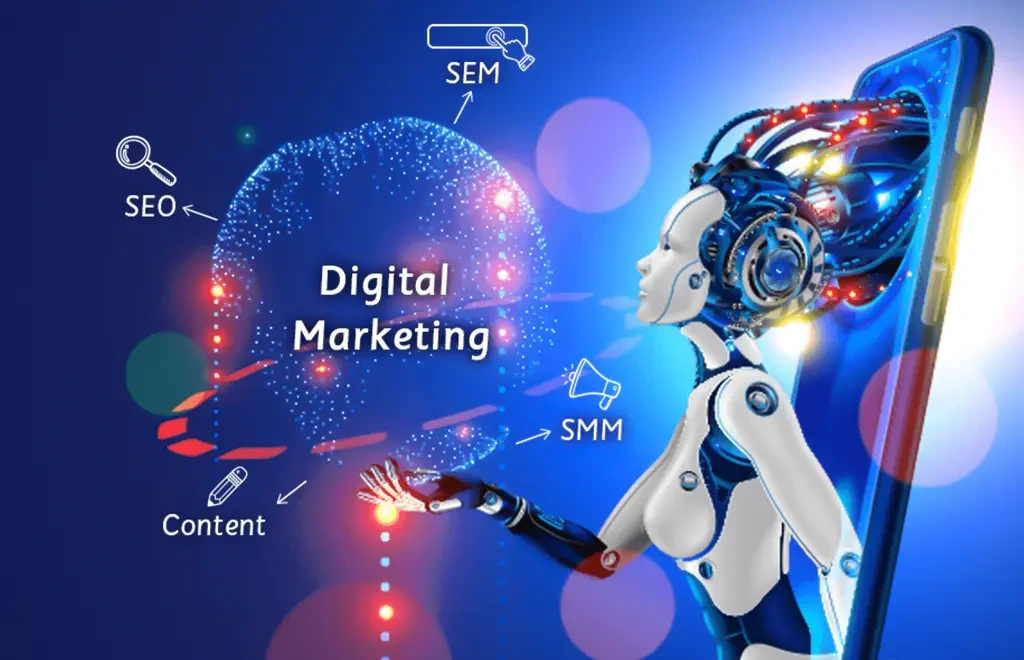
Every marketing conversation I have lately ends up circling back to the same phrase: AI digital marketing. Clients ask about it in kickoff calls, freelancers throw it into their bios, and half the LinkedIn posts in my feed promise it’ll fix everything from low engagement to a shrinking ad budget. Some of that is real. A good chunk of it is noise. Let’s separate the two.
Strip away the buzzword coating, and AI digital marketing just means using machine learning and automation to do the parts of marketing that used to eat up hours — research, targeting, copy drafts, reporting — so people can spend more time on strategy and less on spreadsheets.
It’s not one tool. It’s a mix: chatbots that answer customer questions at 2 a.m., algorithms that decide who sees your Instagram ad, tools that generate ten headline variations before your coffee gets cold, and dashboards that tell you which campaign is actually working instead of just feeling like it’s working.
I’ve used a fair number of these tools myself, mostly for social content and SEO work, and the honest take is: they’re genuinely useful for speed and genuinely bad at judgment. More on that in a minute.
Content creation, at scale. Need twenty Instagram captions for a product launch? AI can draft them in minutes. Someone still has to edit them so they don’t sound like a robot wrote a birthday card, but the first draft used to take an hour and now takes five minutes.
Ad targeting. Meta and Google’s ad platforms have quietly become AI-first. The algorithm now decides who sees your ad based on patterns across millions of accounts — patterns no human media buyer could ever spot manually. This is probably the single area where AI digital marketing has changed the game the most, because it’s invisible and it’s everywhere.
SEO and keyword research. Tools can now scan competitor sites, pull keyword gaps, and flag technical issues (broken schema, missing alt tags, slow load times) faster than a person clicking through Search Console page by page. I still do the audit myself, but I let a tool do the first pass so I’m not starting from zero.
Customer service. Chatbots take care of the where’s my order stuff so that an actual person can talk to the genuinely angry customer. On the analytics side, a model could come from underneath to flag specifics about which accounts are showing signs of potentially churning, instead of guesses. That’s a shift from responding to issues to getting ahead of them, and it may seem small until you’ve lost a client you could have saved.
AI doesn’t have taste. It can throw together a caption for you, but it has no understanding of whether that caption is in line with your brand voice or the other 4 brands that used the same tool with the default settings. I’ve seen AI-written content myself that was perfectly good, but it was bland and forgettable, the type of paragraph you wouldn’t share on social media.
That’s the issue with relying on automated processes to speed up your own work. You make things fast, but then you put out an average product instead of something high-quality.
People are catching on to crummy writing, too. They notice the lack of variation in sentence structure, the use of the same opener phrase, like ‘in today’s digital age,’ that appears on every other LinkedIn article they read. If people begin to realize that your captions are written by an AI, it undercuts any level of authority you were trying to gain by having a consistent social media presence.
If someone asked me how I would integrate AI-powered digital marketing into managing a small company while maintaining my brand identity, I would respond by saying it should be used as a tool for generating ideas or performing some basic operations. It should not be relied on for final results due to the importance of human creativity and individuality. For instance, if the programs are to generate written content, they should do it up to the point of providing general information or guidelines and leave the final and specific parts to humans. This way, the individuality of the brand will be maintained.
The program should also be used for research operations such as identifying keywords used by competitors or summarizing customer feedback, but not for decision-making. It is essential to keep human interaction in the loop, especially when it comes to operations involving clients, even if it is in the form of a chatbot, because it demonstrates that the company cares about its customers. The bot can be used for basic operations like reviewing the status of an order, but not for addressing a customer’s request directly, because such negligence is easily noticed and can damage the company’s reputation.
Check the facts. All of these tools create false statistics and suggest the use of keywords that will actually hurt the ranking. I have seen too many fabricated numbers when reviewing their drafts.
Moreover, most importantly, do not forget that your brand must always be unique. When more than five companies begin to use the same engine with the same settings, the content they produce is almost identical. People will not go to your website if it looks like everyone else’s. Therefore, the uniqueness of the solution lies in critical thinking and divergence from the standard.
My opinion on the use of AI digital marketing tools
AI tools can replace a marketer’s routine and monotonous work. I believe that only 60% of jobs can be delegated to an artificial intelligence tool, leaving 40% for the living person who knows how to develop a good article or build good relationships with the client.
For small operations with limited resources, this is excellent news. Two people can produce what five used to create by employing the right tools while keeping the quality high by continuing to apply human oversight and review to guarantee that the material represents the best qualities of the brand.
The companies and brands that will thrive in the next decade are not the ones that will invest in the most advanced tools. Instead, they will be the ones who can identify when to stop relying on automation and begin incorporating human creativity and expertise.
One final point to elaborate on
In my experience, companies often use AI digital marketing as some sort of subscription service, which is wrong in principle since these mechanisms require constant fine-tuning. This process is lengthy, and the outcomes are only visible if the person responsible for the task regularly follows up on the results. For example, if an organization relies on an AI chatbot to provide responses to customers, there is no guarantee that it will perform at the same level several months later because the tool will not continue to collect and analyze the same data.
A large number of advertisements that use artificial intelligence do not succeed during the creation phase because the tools available are of poor quality. The truth is that most AI tools today require an extended amount of human labor to produce a suitable result. A potential customer may not even notice the difference between a chatbot response and a human message. However, if one decides to use a cheap AI tool, they might as well not use it at all since such services often require additional time and resources to make the output acceptable.
It is important not to rely on miracles from AI-powered digital marketing tools. Even when properly tuned, such mechanisms will not bring relevant results in hours or days after the start. An algorithm needs to collect data for analysis, and the website needs time to load new material for search engine robots. Thus, a company that wants to boost its online presence should not rely on instant success with artificial intelligence.
As a result, organizations need to be patient and take small steps when dealing with AI-driven digital marketing. One instrument is enough for experiments, and one month of continuous work is vital to see the first outcomes.